![[Review] Artificial Intelligence: A Modern Approach, Global Edition (Peter Norvig) Summarized](https://episodes.castos.com/660078c6833215-59505987/images/2328983/c1a-085k3-z3424z54u9m-pmllgr.jpg)
Show Notes
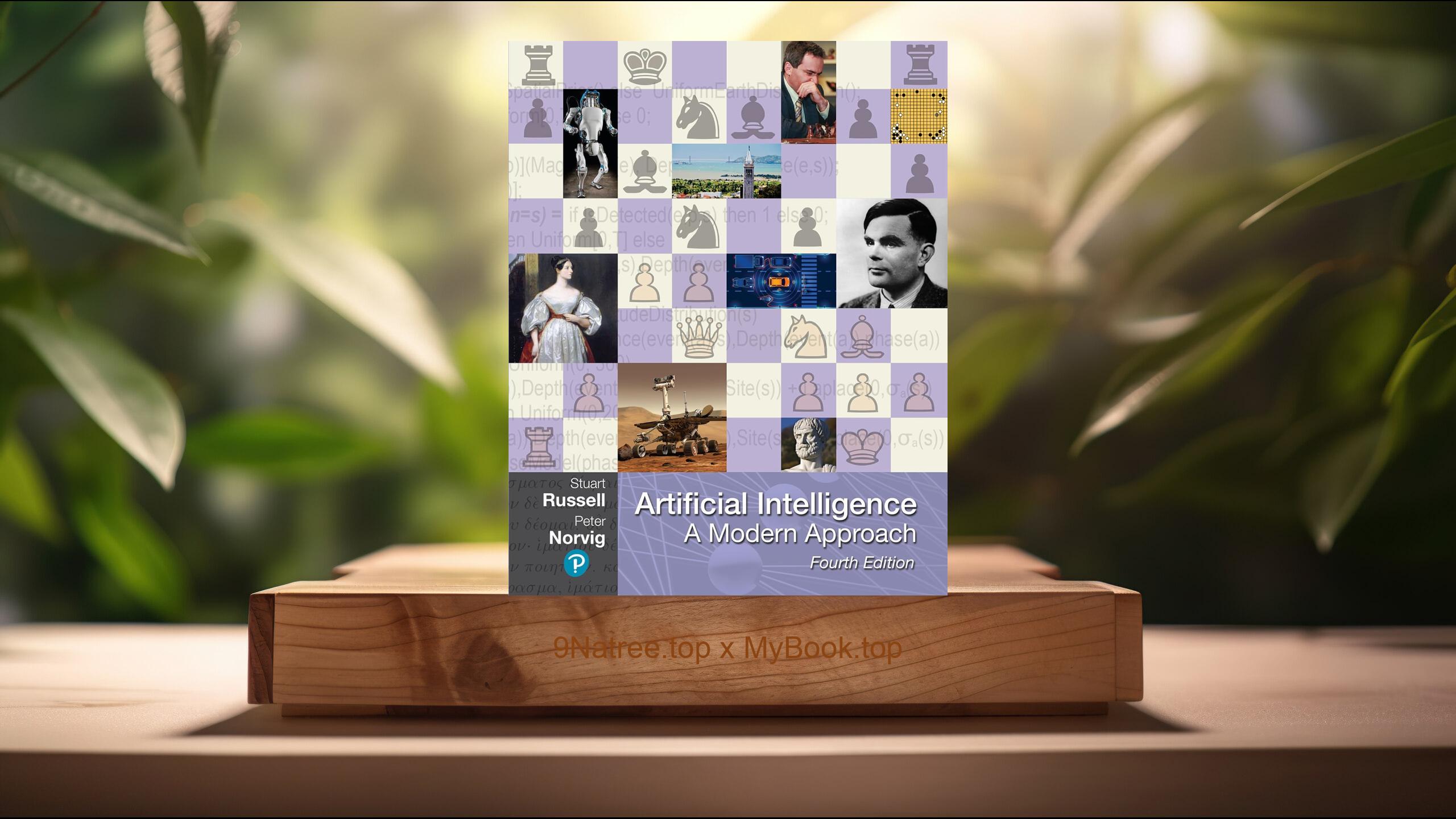
Artificial Intelligence: A Modern Approach, Global Edition (Peter Norvig)
- Amazon USA Store: https://www.amazon.com/dp/1292401133?tag=9natree-20
- Amazon Worldwide Store: https://global.buys.trade/Artificial-Intelligence%3A-A-Modern-Approach%2C-Global-Edition-Peter-Norvig.html
- Apple Books: https://books.apple.com/us/audiobook/the-goal-a-process-of-ongoing-improvement/id1643137702?itsct=books_box_link&itscg=30200&ls=1&at=1001l3bAw&ct=9natree
- eBay: https://www.ebay.com/sch/i.html?_nkw=Artificial+Intelligence+A+Modern+Approach+Global+Edition+Peter+Norvig+&mkcid=1&mkrid=711-53200-19255-0&siteid=0&campid=5339060787&customid=9natree&toolid=10001&mkevt=1
- Read more: https://mybook.top/read/1292401133/
#artificialintelligencetextbook #rationalagents #searchandplanning #probabilisticreasoning #machinelearningfoundations #ArtificialIntelligence
These are takeaways from this book.
Firstly, Rational agents and problem formulation, A central organizing idea is the rational agent, an entity that selects actions expected to maximize a defined performance measure given its percepts and knowledge. This framing helps unify diverse AI topics by keeping attention on goals, constraints, and measurable outcomes rather than on any single technique. The book emphasizes how to translate messy real situations into well specified tasks: defining state representations, actions, transition models, goal tests, utilities, and performance metrics. It also highlights the difference between fully observable versus partially observable environments, deterministic versus stochastic dynamics, and episodic versus sequential tasks. These distinctions directly influence which algorithms are feasible and which assumptions are safe. By treating AI systems as agents embedded in environments, the text naturally introduces the perception to action loop and motivates learning as a way to improve decisions over time. It also clarifies practical issues such as designing reward or utility functions, handling limited computational resources, and choosing between optimality and satisficing solutions. This agent centered viewpoint provides a common language for later chapters, letting readers compare search, reasoning, and learning methods as alternative ways to choose actions intelligently.
Secondly, Search, planning, and the art of making decisions, The book develops classic search and planning as core decision making tools, starting from uninformed search methods and advancing to informed strategies that use heuristics to guide exploration. Readers learn why algorithms like breadth first and uniform cost search have predictable guarantees, and why depth first variants can be efficient yet risky without safeguards. From there, heuristic design and evaluation become a major theme, showing how problem specific knowledge can dramatically reduce computation while still preserving correctness under certain conditions. Beyond single agent problem solving, the text covers adversarial reasoning for competitive settings, connecting game playing to minimax style decision making and pruning techniques that reduce the search space. Planning expands the perspective from finding a path in a state graph to constructing sequences of actions that achieve goals, often using structured representations of actions and constraints. The underlying message is that intelligent behavior frequently depends on representing choices in a way that makes reasoning tractable. This topic also exposes the tradeoff between optimal solutions and computational limits, preparing readers for approximate methods and for combining planning with uncertainty and learning.
Thirdly, Knowledge representation and logical inference, A Modern Approach treats knowledge representation as a design problem: choosing formalisms that capture what an agent needs to know while supporting efficient inference. The book introduces propositional and first order logic as languages for expressing facts, rules, and relationships, then connects them to inference procedures that derive new conclusions. Readers see how expressive power increases with richer representations, but also how computational complexity can grow, motivating careful modeling choices. The text explores how to build knowledge bases, how to use inference to answer queries, and how to reason about actions and change when the world evolves over time. Logical methods offer clarity and correctness, enabling systems to justify decisions through derivations rather than through opaque correlations. At the same time, the book recognizes limitations: purely logical approaches can struggle with uncertainty, noisy data, and incomplete knowledge. This sets up a natural bridge to probabilistic reasoning and learning, where degrees of belief and data driven adaptation become essential. By treating logic as one important pillar rather than the whole field, the topic helps readers appreciate when symbolic reasoning is the right tool and when hybrid approaches are more realistic.
Fourthly, Reasoning under uncertainty with probability and decision theory, Real environments are rarely perfectly predictable, so the book devotes substantial attention to probabilistic modeling and decision making. It explains how probability provides a principled language for representing uncertain beliefs, updating them with evidence, and combining multiple sources of information. Graphical models such as Bayesian networks and related structures are used to encode conditional dependencies compactly, making inference more scalable than naive enumeration in many cases. The text also treats algorithms for probabilistic inference and highlights the computational challenges that arise as models grow, motivating approximate techniques when exact computation is infeasible. Importantly, uncertainty is not only about belief but also about action, so the book connects probability to decision theory through utilities and expected value calculations. This gives a coherent method for choosing actions that balance risk, reward, and information gathering. Sequential decision problems are framed in ways that anticipate modern reinforcement learning and planning under uncertainty. The overall contribution of this topic is a realistic view of intelligence: robust agents must reason with imperfect information, quantify confidence, and act effectively even when outcomes cannot be guaranteed.
Lastly, Machine learning, perception, and modern AI applications, The book presents machine learning as the mechanism that allows agents to improve performance from experience, complementing handcrafted knowledge and fixed heuristics. It covers core learning setups such as supervised learning, where models map inputs to labeled outputs, and unsupervised learning, where structure is inferred from unlabeled data. It also addresses the bias variance tradeoff, generalization, and the importance of evaluation practices that prevent overfitting. Neural networks appear as one family of function approximators among many, placed in context alongside probabilistic and symbolic approaches. Learning is linked to perception tasks like vision and speech, where the complexity of raw sensory inputs makes manual rule writing impractical. The text further connects learning to language processing, showing how representations, uncertainty, and data interact in tasks such as classification and sequence modeling. In robotics and embodied AI, it ties together sensing, localization, planning, and control, emphasizing integration rather than isolated modules. This topic reinforces the idea that modern AI systems are engineered blends of representation, inference, optimization, and data driven adaptation, evaluated by measurable performance in real tasks.
- Amazon USA Store: https://www.amazon.com/dp/1292401133?tag=9natree-20
- Amazon Worldwide Store: https://global.buys.trade/Artificial-Intelligence%3A-A-Modern-Approach%2C-Global-Edition-Peter-Norvig.html
- Apple Books: https://books.apple.com/us/audiobook/the-goal-a-process-of-ongoing-improvement/id1643137702?itsct=books_box_link&itscg=30200&ls=1&at=1001l3bAw&ct=9natree
- eBay: https://www.ebay.com/sch/i.html?_nkw=Artificial+Intelligence+A+Modern+Approach+Global+Edition+Peter+Norvig+&mkcid=1&mkrid=711-53200-19255-0&siteid=0&campid=5339060787&customid=9natree&toolid=10001&mkevt=1
- Read more: https://mybook.top/read/1292401133/
#artificialintelligencetextbook #rationalagents #searchandplanning #probabilisticreasoning #machinelearningfoundations #ArtificialIntelligence
These are takeaways from this book.
Firstly, Rational agents and problem formulation, A central organizing idea is the rational agent, an entity that selects actions expected to maximize a defined performance measure given its percepts and knowledge. This framing helps unify diverse AI topics by keeping attention on goals, constraints, and measurable outcomes rather than on any single technique. The book emphasizes how to translate messy real situations into well specified tasks: defining state representations, actions, transition models, goal tests, utilities, and performance metrics. It also highlights the difference between fully observable versus partially observable environments, deterministic versus stochastic dynamics, and episodic versus sequential tasks. These distinctions directly influence which algorithms are feasible and which assumptions are safe. By treating AI systems as agents embedded in environments, the text naturally introduces the perception to action loop and motivates learning as a way to improve decisions over time. It also clarifies practical issues such as designing reward or utility functions, handling limited computational resources, and choosing between optimality and satisficing solutions. This agent centered viewpoint provides a common language for later chapters, letting readers compare search, reasoning, and learning methods as alternative ways to choose actions intelligently.
Secondly, Search, planning, and the art of making decisions, The book develops classic search and planning as core decision making tools, starting from uninformed search methods and advancing to informed strategies that use heuristics to guide exploration. Readers learn why algorithms like breadth first and uniform cost search have predictable guarantees, and why depth first variants can be efficient yet risky without safeguards. From there, heuristic design and evaluation become a major theme, showing how problem specific knowledge can dramatically reduce computation while still preserving correctness under certain conditions. Beyond single agent problem solving, the text covers adversarial reasoning for competitive settings, connecting game playing to minimax style decision making and pruning techniques that reduce the search space. Planning expands the perspective from finding a path in a state graph to constructing sequences of actions that achieve goals, often using structured representations of actions and constraints. The underlying message is that intelligent behavior frequently depends on representing choices in a way that makes reasoning tractable. This topic also exposes the tradeoff between optimal solutions and computational limits, preparing readers for approximate methods and for combining planning with uncertainty and learning.
Thirdly, Knowledge representation and logical inference, A Modern Approach treats knowledge representation as a design problem: choosing formalisms that capture what an agent needs to know while supporting efficient inference. The book introduces propositional and first order logic as languages for expressing facts, rules, and relationships, then connects them to inference procedures that derive new conclusions. Readers see how expressive power increases with richer representations, but also how computational complexity can grow, motivating careful modeling choices. The text explores how to build knowledge bases, how to use inference to answer queries, and how to reason about actions and change when the world evolves over time. Logical methods offer clarity and correctness, enabling systems to justify decisions through derivations rather than through opaque correlations. At the same time, the book recognizes limitations: purely logical approaches can struggle with uncertainty, noisy data, and incomplete knowledge. This sets up a natural bridge to probabilistic reasoning and learning, where degrees of belief and data driven adaptation become essential. By treating logic as one important pillar rather than the whole field, the topic helps readers appreciate when symbolic reasoning is the right tool and when hybrid approaches are more realistic.
Fourthly, Reasoning under uncertainty with probability and decision theory, Real environments are rarely perfectly predictable, so the book devotes substantial attention to probabilistic modeling and decision making. It explains how probability provides a principled language for representing uncertain beliefs, updating them with evidence, and combining multiple sources of information. Graphical models such as Bayesian networks and related structures are used to encode conditional dependencies compactly, making inference more scalable than naive enumeration in many cases. The text also treats algorithms for probabilistic inference and highlights the computational challenges that arise as models grow, motivating approximate techniques when exact computation is infeasible. Importantly, uncertainty is not only about belief but also about action, so the book connects probability to decision theory through utilities and expected value calculations. This gives a coherent method for choosing actions that balance risk, reward, and information gathering. Sequential decision problems are framed in ways that anticipate modern reinforcement learning and planning under uncertainty. The overall contribution of this topic is a realistic view of intelligence: robust agents must reason with imperfect information, quantify confidence, and act effectively even when outcomes cannot be guaranteed.
Lastly, Machine learning, perception, and modern AI applications, The book presents machine learning as the mechanism that allows agents to improve performance from experience, complementing handcrafted knowledge and fixed heuristics. It covers core learning setups such as supervised learning, where models map inputs to labeled outputs, and unsupervised learning, where structure is inferred from unlabeled data. It also addresses the bias variance tradeoff, generalization, and the importance of evaluation practices that prevent overfitting. Neural networks appear as one family of function approximators among many, placed in context alongside probabilistic and symbolic approaches. Learning is linked to perception tasks like vision and speech, where the complexity of raw sensory inputs makes manual rule writing impractical. The text further connects learning to language processing, showing how representations, uncertainty, and data interact in tasks such as classification and sequence modeling. In robotics and embodied AI, it ties together sensing, localization, planning, and control, emphasizing integration rather than isolated modules. This topic reinforces the idea that modern AI systems are engineered blends of representation, inference, optimization, and data driven adaptation, evaluated by measurable performance in real tasks.