![[Review] Artificial Intelligence: A Modern Approach (Stuart Russell) Summarized](https://episodes.castos.com/660078c6833215-59505987/images/2328992/c1a-085k3-jpqdq22rcp87-blmnq2.jpg)
Show Notes
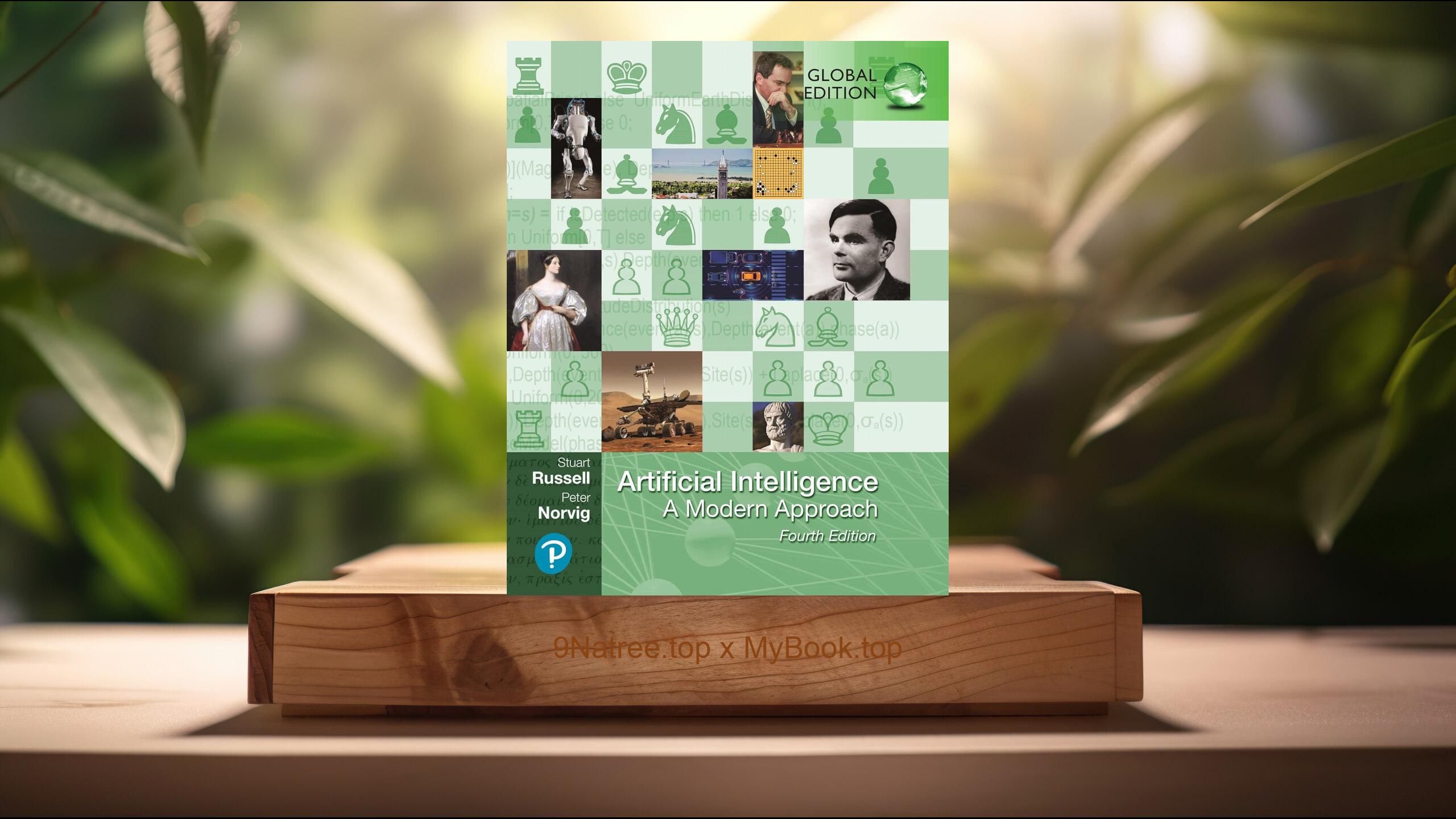
Artificial Intelligence: A Modern Approach (Stuart Russell)
- Amazon USA Store: https://www.amazon.com/dp/0134610997?tag=9natree-20
- Amazon Worldwide Store: https://global.buys.trade/Artificial-Intelligence%3A-A-Modern-Approach-Stuart-Russell.html
- Apple Books: https://books.apple.com/us/audiobook/inside-the-last-thing-he-told-me-on-tv-a/id1683488096?itsct=books_box_link&itscg=30200&ls=1&at=1001l3bAw&ct=9natree
- eBay: https://www.ebay.com/sch/i.html?_nkw=Artificial+Intelligence+A+Modern+Approach+Stuart+Russell+&mkcid=1&mkrid=711-53200-19255-0&siteid=0&campid=5339060787&customid=9natree&toolid=10001&mkevt=1
- Read more: https://mybook.top/read/0134610997/
#artificialintelligencetextbook #rationalagents #searchalgorithms #probabilisticreasoning #machinelearningfundamentals #ArtificialIntelligence
These are takeaways from this book.
Firstly, Rational Agents as the Unifying Framework, A central idea in the book is to define AI through the lens of rational agents. Instead of treating intelligence as a vague human like quality, the agent viewpoint asks a concrete engineering question: given what an entity can perceive and the actions it can take, how should it choose actions that best achieve its objectives. This framing naturally introduces performance measures, environments, and the difference between fully observable and partially observable worlds. It clarifies why the same agent might need different strategies depending on whether outcomes are deterministic or stochastic, static or dynamic, single agent or multiagent. The agent model also creates a common language for comparing systems that look very different, such as a chess program, a medical diagnosis assistant, or a self driving robot. By grounding AI in decision making under constraints, it helps readers evaluate what counts as success, how to benchmark progress, and where assumptions break. The approach also encourages thinking about modular design: sensing, state estimation, decision policies, and learning components that can improve performance over time. This perspective is especially valuable because it connects foundational topics like search and logic with modern themes like data driven learning and real world autonomy.
Secondly, Search and Problem Solving for Goal Directed Behavior, The book presents classical search as one of the first practical ways to build goal directed behavior. It explains how many tasks can be formulated as state spaces with actions, costs, and goal tests, then solved using systematic exploration. Readers learn why blind methods such as breadth first or depth first search can be useful but often scale poorly, and how informed methods like heuristic search exploit problem structure to guide exploration efficiently. Concepts such as optimality, completeness, and time space complexity provide a disciplined way to compare algorithms rather than relying on intuition. The text also covers local search strategies for optimization style tasks, where finding a good solution matters more than proving it is the best. It ties these ideas to real applications, including path finding, scheduling, and puzzle like planning. Importantly, the book highlights that good heuristics are often the difference between theory and workable systems, and it discusses how heuristics can be designed or learned. This section serves as a foundation for later topics because search is not just an early historical technique, it is also embedded in planning, game playing, inference, and even some learning methods. Understanding search teaches readers to think in terms of representations, tradeoffs, and systematic algorithmic design.
Thirdly, Knowledge Representation and Logical Reasoning, Another major theme is how to represent facts about the world and reason from them. The book surveys logic based approaches, showing how formal languages can encode objects, relations, rules, and constraints in a way that supports sound inference. This includes propositional logic for simple true false structure and more expressive forms such as first order logic that can describe general rules about categories of things. Readers see how inference procedures can derive new conclusions, detect inconsistencies, and answer queries, and why complexity becomes a practical challenge as expressiveness grows. The discussion also addresses common knowledge engineering issues such as choosing the right level of abstraction, handling defaults and exceptions, and modeling actions and change. These tools are central to building systems that need explicit explanations or reliable rule governed behavior, such as configuration, compliance, and certain decision support tasks. The book positions logic not as a competitor to machine learning but as a complementary toolkit, especially when data is scarce, constraints are strict, or interpretability is required. By connecting representation choices to reasoning performance and system behavior, it teaches readers to see knowledge as an engineered artifact that must be designed, maintained, and tested like any other component.
Fourthly, Probabilistic Models and Decision Making Under Uncertainty, Real environments are noisy and partially observable, so the book devotes significant attention to probabilistic reasoning and decision making. It introduces probability as a language for uncertainty, then shows how structured models like Bayesian networks capture dependencies among variables while keeping inference tractable in many cases. Readers learn how to compute beliefs from evidence, how conditional independence simplifies reasoning, and how algorithms can approximate answers when exact inference is too expensive. The text connects probabilistic inference to sequential settings through temporal models, which are useful for tracking hidden state over time, such as estimating a robot position or monitoring system health. Building on belief, it extends to decisions: utilities, preferences, and expected utility maximization provide a principled way to choose actions when outcomes are uncertain. This leads naturally to topics like Markov decision processes and policies for long term reward. The emphasis is not only on formulas but on modeling choices: what variables to include, how to gather data, and how to evaluate whether a model captures reality well enough for the task. This part of the book is valuable because it bridges perception, learning, and control, and it equips readers with a framework that is widely used in modern AI systems where uncertainty is unavoidable.
Lastly, Machine Learning, Deep Learning, and Building AI Systems Responsibly, The book covers machine learning as the set of methods that allow agents to improve with experience. It explains core ideas such as training versus generalization, overfitting, model selection, and evaluation, helping readers understand why performance on new data is the true test of learning. It surveys major paradigms including supervised learning for prediction, unsupervised learning for structure discovery, and reinforcement learning for learning from interaction and reward. The treatment places these methods within the larger AI pipeline: data representation, feature choices, optimization, and the role of inductive bias. It also connects learning to other topics such as probabilistic modeling and decision making, showing how learned models can support planning and control. Alongside technical content, the book discusses broader considerations: what it means to deploy systems safely, how objectives can be misspecified, and why evaluation must include reliability and real world impact, not just benchmark scores. This combination helps readers avoid seeing learning as a magic box and instead approach it as an engineering discipline with failure modes, assumptions, and tradeoffs. By integrating modern learning with classical AI foundations, it supports a balanced understanding that remains relevant across changing toolsets and trends.
- Amazon USA Store: https://www.amazon.com/dp/0134610997?tag=9natree-20
- Amazon Worldwide Store: https://global.buys.trade/Artificial-Intelligence%3A-A-Modern-Approach-Stuart-Russell.html
- Apple Books: https://books.apple.com/us/audiobook/inside-the-last-thing-he-told-me-on-tv-a/id1683488096?itsct=books_box_link&itscg=30200&ls=1&at=1001l3bAw&ct=9natree
- eBay: https://www.ebay.com/sch/i.html?_nkw=Artificial+Intelligence+A+Modern+Approach+Stuart+Russell+&mkcid=1&mkrid=711-53200-19255-0&siteid=0&campid=5339060787&customid=9natree&toolid=10001&mkevt=1
- Read more: https://mybook.top/read/0134610997/
#artificialintelligencetextbook #rationalagents #searchalgorithms #probabilisticreasoning #machinelearningfundamentals #ArtificialIntelligence
These are takeaways from this book.
Firstly, Rational Agents as the Unifying Framework, A central idea in the book is to define AI through the lens of rational agents. Instead of treating intelligence as a vague human like quality, the agent viewpoint asks a concrete engineering question: given what an entity can perceive and the actions it can take, how should it choose actions that best achieve its objectives. This framing naturally introduces performance measures, environments, and the difference between fully observable and partially observable worlds. It clarifies why the same agent might need different strategies depending on whether outcomes are deterministic or stochastic, static or dynamic, single agent or multiagent. The agent model also creates a common language for comparing systems that look very different, such as a chess program, a medical diagnosis assistant, or a self driving robot. By grounding AI in decision making under constraints, it helps readers evaluate what counts as success, how to benchmark progress, and where assumptions break. The approach also encourages thinking about modular design: sensing, state estimation, decision policies, and learning components that can improve performance over time. This perspective is especially valuable because it connects foundational topics like search and logic with modern themes like data driven learning and real world autonomy.
Secondly, Search and Problem Solving for Goal Directed Behavior, The book presents classical search as one of the first practical ways to build goal directed behavior. It explains how many tasks can be formulated as state spaces with actions, costs, and goal tests, then solved using systematic exploration. Readers learn why blind methods such as breadth first or depth first search can be useful but often scale poorly, and how informed methods like heuristic search exploit problem structure to guide exploration efficiently. Concepts such as optimality, completeness, and time space complexity provide a disciplined way to compare algorithms rather than relying on intuition. The text also covers local search strategies for optimization style tasks, where finding a good solution matters more than proving it is the best. It ties these ideas to real applications, including path finding, scheduling, and puzzle like planning. Importantly, the book highlights that good heuristics are often the difference between theory and workable systems, and it discusses how heuristics can be designed or learned. This section serves as a foundation for later topics because search is not just an early historical technique, it is also embedded in planning, game playing, inference, and even some learning methods. Understanding search teaches readers to think in terms of representations, tradeoffs, and systematic algorithmic design.
Thirdly, Knowledge Representation and Logical Reasoning, Another major theme is how to represent facts about the world and reason from them. The book surveys logic based approaches, showing how formal languages can encode objects, relations, rules, and constraints in a way that supports sound inference. This includes propositional logic for simple true false structure and more expressive forms such as first order logic that can describe general rules about categories of things. Readers see how inference procedures can derive new conclusions, detect inconsistencies, and answer queries, and why complexity becomes a practical challenge as expressiveness grows. The discussion also addresses common knowledge engineering issues such as choosing the right level of abstraction, handling defaults and exceptions, and modeling actions and change. These tools are central to building systems that need explicit explanations or reliable rule governed behavior, such as configuration, compliance, and certain decision support tasks. The book positions logic not as a competitor to machine learning but as a complementary toolkit, especially when data is scarce, constraints are strict, or interpretability is required. By connecting representation choices to reasoning performance and system behavior, it teaches readers to see knowledge as an engineered artifact that must be designed, maintained, and tested like any other component.
Fourthly, Probabilistic Models and Decision Making Under Uncertainty, Real environments are noisy and partially observable, so the book devotes significant attention to probabilistic reasoning and decision making. It introduces probability as a language for uncertainty, then shows how structured models like Bayesian networks capture dependencies among variables while keeping inference tractable in many cases. Readers learn how to compute beliefs from evidence, how conditional independence simplifies reasoning, and how algorithms can approximate answers when exact inference is too expensive. The text connects probabilistic inference to sequential settings through temporal models, which are useful for tracking hidden state over time, such as estimating a robot position or monitoring system health. Building on belief, it extends to decisions: utilities, preferences, and expected utility maximization provide a principled way to choose actions when outcomes are uncertain. This leads naturally to topics like Markov decision processes and policies for long term reward. The emphasis is not only on formulas but on modeling choices: what variables to include, how to gather data, and how to evaluate whether a model captures reality well enough for the task. This part of the book is valuable because it bridges perception, learning, and control, and it equips readers with a framework that is widely used in modern AI systems where uncertainty is unavoidable.
Lastly, Machine Learning, Deep Learning, and Building AI Systems Responsibly, The book covers machine learning as the set of methods that allow agents to improve with experience. It explains core ideas such as training versus generalization, overfitting, model selection, and evaluation, helping readers understand why performance on new data is the true test of learning. It surveys major paradigms including supervised learning for prediction, unsupervised learning for structure discovery, and reinforcement learning for learning from interaction and reward. The treatment places these methods within the larger AI pipeline: data representation, feature choices, optimization, and the role of inductive bias. It also connects learning to other topics such as probabilistic modeling and decision making, showing how learned models can support planning and control. Alongside technical content, the book discusses broader considerations: what it means to deploy systems safely, how objectives can be misspecified, and why evaluation must include reliability and real world impact, not just benchmark scores. This combination helps readers avoid seeing learning as a magic box and instead approach it as an engineering discipline with failure modes, assumptions, and tradeoffs. By integrating modern learning with classical AI foundations, it supports a balanced understanding that remains relevant across changing toolsets and trends.