![[Review] Fundamentals of Astrodynamics (Roger R. Bate) Summarized](https://episodes.castos.com/660078c6833215-59505987/images/2352629/c1a-085k3-8d0mz9xjfv89-bvyoip.jpg)
Show Notes
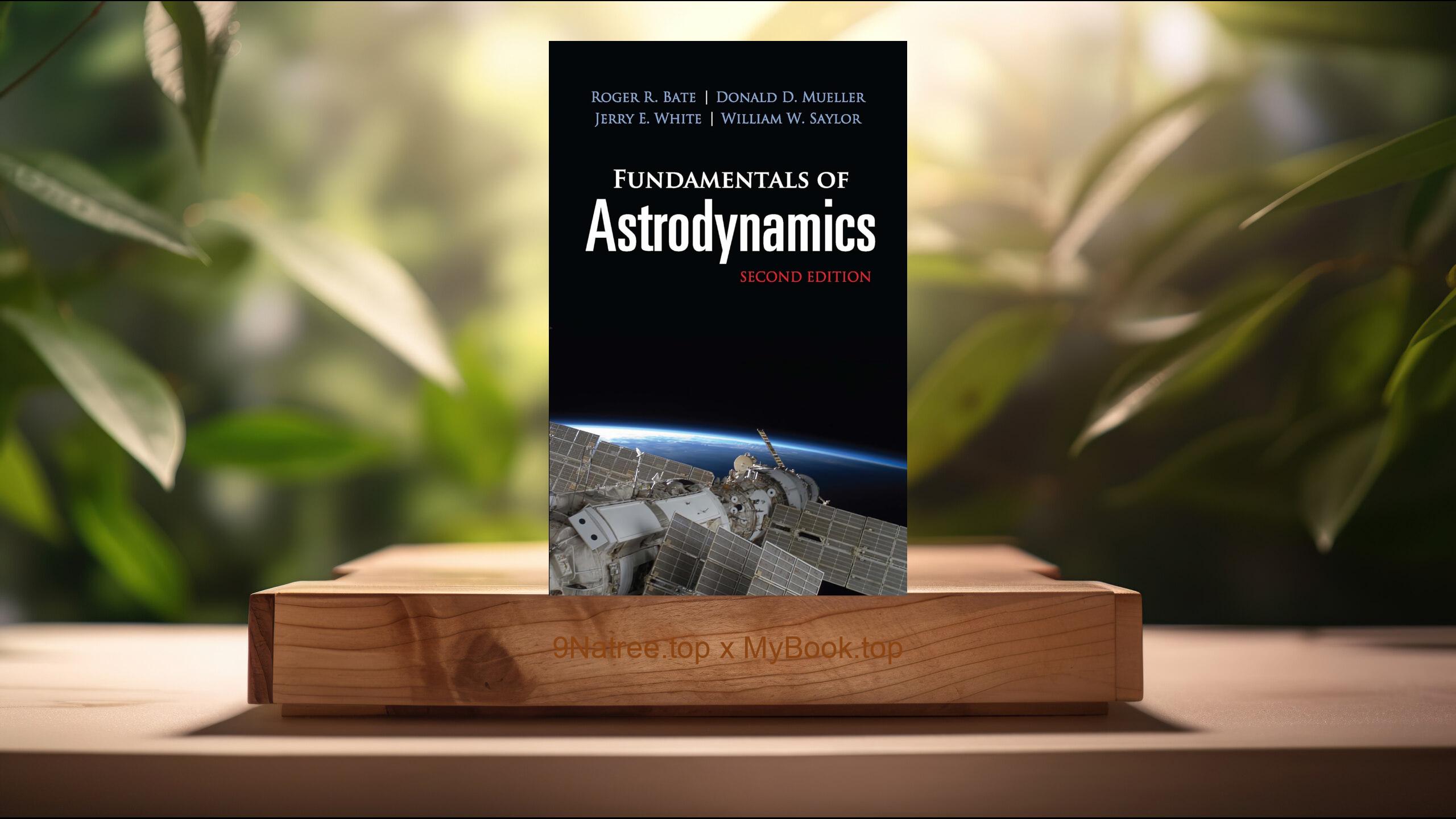
Fundamentals of Astrodynamics (Roger R. Bate)
- Amazon USA Store: https://www.amazon.com/dp/0486600610?tag=9natree-20
- Amazon Worldwide Store: https://global.buys.trade/Fundamentals-of-Astrodynamics-Roger-R-Bate.html
- eBay: https://www.ebay.com/sch/i.html?_nkw=Fundamentals+of+Astrodynamics+Roger+R+Bate+&mkcid=1&mkrid=711-53200-19255-0&siteid=0&campid=5339060787&customid=9natree&toolid=10001&mkevt=1
- Read more: https://english.9natree.com/read/0486600610/
#orbitalmechanics #twobodyproblem #Keplersequation #orbitalelements #spacecrafttrajectory #impulsivemaneuvers #rendezvousanddocking #interplanetarytransfer #FundamentalsofAstrodynamics
These are takeaways from this book.
Firstly, The Two Body Problem as the Core Model, A central theme of the book is that much of astrodynamics can be built on the two body problem, the idealized case where a spacecraft and a primary body interact only through Newtonian gravity. The text develops the equations of motion, the inverse square law, and the conservation principles that make the model solvable, including conservation of angular momentum and mechanical energy. From these invariants, the reader learns why trajectories are conic sections and how orbit shape and orientation emerge from initial position and velocity. The book emphasizes practical interpretation: what changes in speed do to orbit size, what changes in direction do to orbit plane, and how the balance between kinetic and potential energy determines whether the path is elliptic, parabolic, or hyperbolic. This foundational model becomes a baseline for all later topics, because even when additional forces exist, engineers frequently start from a two body approximation and then apply corrections. By mastering this section, readers gain the ability to quickly estimate orbit behavior, sanity-check numerical results, and understand where common formulas come from rather than treating them as memorized rules.
Secondly, Orbit Geometry and Classical Orbital Elements, The book explains how orbits are described geometrically and how that geometry is encoded in classical orbital elements. Instead of relying on pictures alone, it connects the orbit plane, line of nodes, and periapsis direction to coordinate transformations that allow engineers to move between inertial frames and orbit-based frames. Key elements such as semi-major axis, eccentricity, inclination, right ascension of the ascending node, argument of periapsis, and true anomaly are treated as a compact language for orbit definition. The reader sees how each element influences the trajectory: size and period, shape, tilt, and the orientation of the ellipse in space. Equally important is the practical skill of converting between state vectors and orbital elements, since navigation and mission design often alternate between these representations. The text’s approach highlights why different element sets can become numerically fragile near special cases like near-circular or near-equatorial orbits and why careful selection of parameters matters. By the end of this topic, readers can interpret orbit descriptions, predict qualitative motion, and prepare inputs for transfer and targeting calculations.
Thirdly, Time of Flight, Kepler’s Equation, and Orbit Propagation, Predicting where a spacecraft will be at a future time requires connecting orbital geometry to time, and the book develops this connection through Keplerian motion. It treats orbital period relations, mean motion, and the relationship between true anomaly and time via eccentric anomaly and mean anomaly. A major practical hurdle, solving Kepler’s equation, is presented as an engineering problem: how to compute position along an ellipse given time of flight, and how numerical methods and iterative approaches enter even in an otherwise analytical discipline. The text also covers related concepts such as the flight path angle and radial and transverse velocity components, which are essential for understanding how velocity changes along an orbit and for planning burns. This topic equips readers to perform basic orbit propagation, estimate rendezvous timing opportunities, and compute transfer arrival conditions. Beyond the computations, the value lies in building intuition for why equal areas correspond to equal times and how eccentricity changes the pacing of motion. For anyone working with mission timelines, ground track planning, or targeting, these methods form the backbone of first-order prediction.
Fourthly, Impulsive Maneuvers and Orbit Transfer Strategies, A large portion of practical astrodynamics involves changing orbits using propulsion, and the book focuses on impulsive maneuvers as an idealization that makes transfer analysis tractable. It explains how a brief velocity change alters energy and angular momentum, and how that translates into new orbital elements. Classic transfers such as coplanar and non-coplanar changes are analyzed with attention to where burns should occur to minimize required delta v. The text builds tools for comparing strategies, including understanding plane change costs, the efficiency of performing plane changes at low speed locations, and the logic behind combining maneuvers when possible. It also provides the conceptual basis for widely used transfer patterns such as moving between circular orbits with intermediate ellipses and timing transfers to meet phase constraints. While real engines have finite burn durations, the impulsive model remains a key design step and a strong approximation for high-thrust systems. Readers learn to structure problems clearly: define initial and final orbits, decide which parameters must match, select candidate maneuvers, and compute the resulting delta v and timing. This topic directly supports mission design tasks from satellite orbit raising to inter-orbit logistics.
Lastly, Rendezvous, Relative Motion, and Interplanetary Concepts, The book extends core orbital mechanics into mission-oriented applications that require targeting and meeting specific conditions. Rendezvous problems introduce relative motion thinking, where the goal is not just reaching an orbit but arriving at the same place and time as another object. This demands careful use of phasing, transfer timing, and matching position and velocity at intercept. The text also addresses broader trajectory ideas relevant to leaving one gravitational environment and arriving at another, including hyperbolic motion, escape and capture energy concepts, and patched-conic style reasoning that connects two body arcs around different primaries. These tools underpin interplanetary transfers, where the spacecraft follows heliocentric motion between planetary spheres of influence and uses hyperbolic approaches near departure and arrival planets. Even if later refinements are needed, the book’s treatment provides the first-order framework used to select launch windows, estimate characteristic energy needs, and understand how arrival speed relates to capture requirements. Readers come away able to frame complex missions as sequences of simpler arcs, recognize the key constraints that drive feasibility, and communicate trajectory logic in a disciplined, engineering-friendly way.
- Amazon USA Store: https://www.amazon.com/dp/0486600610?tag=9natree-20
- Amazon Worldwide Store: https://global.buys.trade/Fundamentals-of-Astrodynamics-Roger-R-Bate.html
- eBay: https://www.ebay.com/sch/i.html?_nkw=Fundamentals+of+Astrodynamics+Roger+R+Bate+&mkcid=1&mkrid=711-53200-19255-0&siteid=0&campid=5339060787&customid=9natree&toolid=10001&mkevt=1
- Read more: https://english.9natree.com/read/0486600610/
#orbitalmechanics #twobodyproblem #Keplersequation #orbitalelements #spacecrafttrajectory #impulsivemaneuvers #rendezvousanddocking #interplanetarytransfer #FundamentalsofAstrodynamics
These are takeaways from this book.
Firstly, The Two Body Problem as the Core Model, A central theme of the book is that much of astrodynamics can be built on the two body problem, the idealized case where a spacecraft and a primary body interact only through Newtonian gravity. The text develops the equations of motion, the inverse square law, and the conservation principles that make the model solvable, including conservation of angular momentum and mechanical energy. From these invariants, the reader learns why trajectories are conic sections and how orbit shape and orientation emerge from initial position and velocity. The book emphasizes practical interpretation: what changes in speed do to orbit size, what changes in direction do to orbit plane, and how the balance between kinetic and potential energy determines whether the path is elliptic, parabolic, or hyperbolic. This foundational model becomes a baseline for all later topics, because even when additional forces exist, engineers frequently start from a two body approximation and then apply corrections. By mastering this section, readers gain the ability to quickly estimate orbit behavior, sanity-check numerical results, and understand where common formulas come from rather than treating them as memorized rules.
Secondly, Orbit Geometry and Classical Orbital Elements, The book explains how orbits are described geometrically and how that geometry is encoded in classical orbital elements. Instead of relying on pictures alone, it connects the orbit plane, line of nodes, and periapsis direction to coordinate transformations that allow engineers to move between inertial frames and orbit-based frames. Key elements such as semi-major axis, eccentricity, inclination, right ascension of the ascending node, argument of periapsis, and true anomaly are treated as a compact language for orbit definition. The reader sees how each element influences the trajectory: size and period, shape, tilt, and the orientation of the ellipse in space. Equally important is the practical skill of converting between state vectors and orbital elements, since navigation and mission design often alternate between these representations. The text’s approach highlights why different element sets can become numerically fragile near special cases like near-circular or near-equatorial orbits and why careful selection of parameters matters. By the end of this topic, readers can interpret orbit descriptions, predict qualitative motion, and prepare inputs for transfer and targeting calculations.
Thirdly, Time of Flight, Kepler’s Equation, and Orbit Propagation, Predicting where a spacecraft will be at a future time requires connecting orbital geometry to time, and the book develops this connection through Keplerian motion. It treats orbital period relations, mean motion, and the relationship between true anomaly and time via eccentric anomaly and mean anomaly. A major practical hurdle, solving Kepler’s equation, is presented as an engineering problem: how to compute position along an ellipse given time of flight, and how numerical methods and iterative approaches enter even in an otherwise analytical discipline. The text also covers related concepts such as the flight path angle and radial and transverse velocity components, which are essential for understanding how velocity changes along an orbit and for planning burns. This topic equips readers to perform basic orbit propagation, estimate rendezvous timing opportunities, and compute transfer arrival conditions. Beyond the computations, the value lies in building intuition for why equal areas correspond to equal times and how eccentricity changes the pacing of motion. For anyone working with mission timelines, ground track planning, or targeting, these methods form the backbone of first-order prediction.
Fourthly, Impulsive Maneuvers and Orbit Transfer Strategies, A large portion of practical astrodynamics involves changing orbits using propulsion, and the book focuses on impulsive maneuvers as an idealization that makes transfer analysis tractable. It explains how a brief velocity change alters energy and angular momentum, and how that translates into new orbital elements. Classic transfers such as coplanar and non-coplanar changes are analyzed with attention to where burns should occur to minimize required delta v. The text builds tools for comparing strategies, including understanding plane change costs, the efficiency of performing plane changes at low speed locations, and the logic behind combining maneuvers when possible. It also provides the conceptual basis for widely used transfer patterns such as moving between circular orbits with intermediate ellipses and timing transfers to meet phase constraints. While real engines have finite burn durations, the impulsive model remains a key design step and a strong approximation for high-thrust systems. Readers learn to structure problems clearly: define initial and final orbits, decide which parameters must match, select candidate maneuvers, and compute the resulting delta v and timing. This topic directly supports mission design tasks from satellite orbit raising to inter-orbit logistics.
Lastly, Rendezvous, Relative Motion, and Interplanetary Concepts, The book extends core orbital mechanics into mission-oriented applications that require targeting and meeting specific conditions. Rendezvous problems introduce relative motion thinking, where the goal is not just reaching an orbit but arriving at the same place and time as another object. This demands careful use of phasing, transfer timing, and matching position and velocity at intercept. The text also addresses broader trajectory ideas relevant to leaving one gravitational environment and arriving at another, including hyperbolic motion, escape and capture energy concepts, and patched-conic style reasoning that connects two body arcs around different primaries. These tools underpin interplanetary transfers, where the spacecraft follows heliocentric motion between planetary spheres of influence and uses hyperbolic approaches near departure and arrival planets. Even if later refinements are needed, the book’s treatment provides the first-order framework used to select launch windows, estimate characteristic energy needs, and understand how arrival speed relates to capture requirements. Readers come away able to frame complex missions as sequences of simpler arcs, recognize the key constraints that drive feasibility, and communicate trajectory logic in a disciplined, engineering-friendly way.